

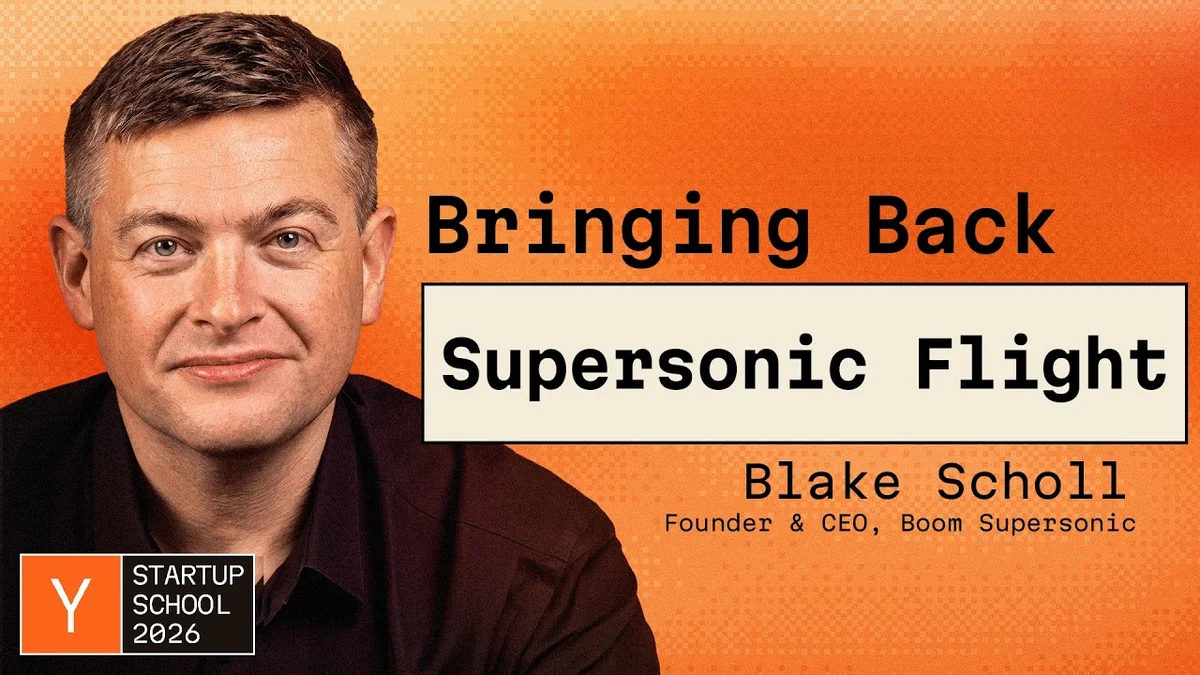
Boom's Blake Scholl: "The Future Was Supposed to Be Faster"

Boom Supersonic CEO Blake Scholl discusses the stagnation of air travel innovation and his company's mission to bring back supersonic flight, highlighting technological breakthroughs and lessons learned.

11 min read
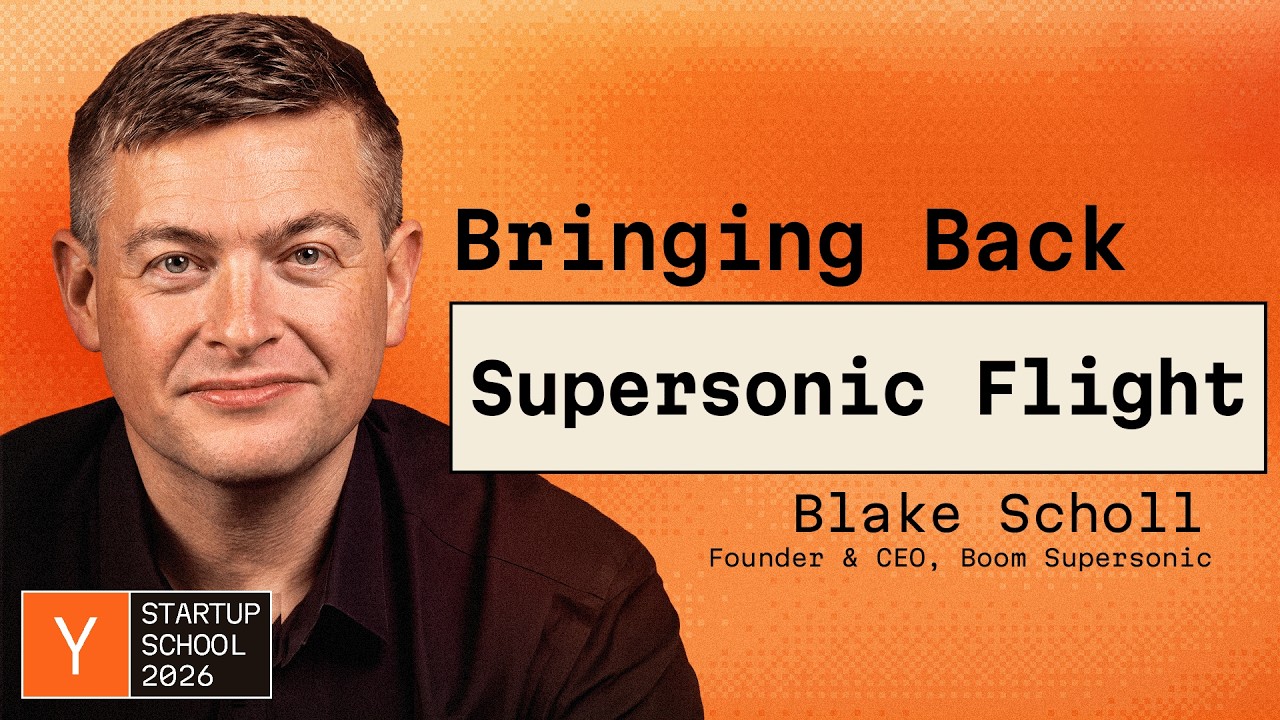
Blake Scholl speaking on stage at Y Combinator Startup School
YC

Visual TL;DR. Air Travel Stagnation leads to idea Future Was Faster. Future Was Faster drives Boom Supersonic Mission. Air Travel Stagnation problem addressed by Boom Supersonic Mission. Boom Supersonic Mission requires Tech Breakthroughs. Boom Supersonic Mission utilizes Software Principles. Tech Breakthroughs helps with Overcoming Challenges. Software Principles aids in Overcoming Challenges. Overcoming Challenges enables Supersonic Future. Boom Supersonic Mission achieves Supersonic Future.

  1. Air Travel Stagnation: current air travel is slow, not much faster than 50 years ago
  2. Future Was Faster: Blake Scholl argues the future was supposed to be faster and better
  3. Boom Supersonic Mission: company aims to bring back supersonic passenger travel with new tech
  4. Tech Breakthroughs: leveraging advancements in materials, aerodynamics, and propulsion systems
  5. Software Principles: revolutionizing hardware development by applying agile software methodologies
  6. Overcoming Challenges: addressing noise, fuel efficiency, and regulatory hurdles for commercial viability
  7. Supersonic Future: envisioning a world where travel is significantly faster and more accessible
Visual TL;DR
Visual TL;DR, startuphub.ai Air Travel Stagnation problem addressed by Boom Supersonic Mission. Boom Supersonic Mission utilizes Software Principles. Boom Supersonic Mission achieves Supersonic Future problem addressed by utilizes achieves Air Travel Stagnation Boom Supersonic Mission Software Principles Supersonic Future From startuphub.ai · The publishers behind this format
Visual TL;DR, startuphub.ai Air Travel Stagnation problem addressed by Boom Supersonic Mission. Boom Supersonic Mission utilizes Software Principles. Boom Supersonic Mission achieves Supersonic Future problem addressed by utilizes achieves Air TravelStagnation Boom SupersonicMission SoftwarePrinciples Supersonic Future From startuphub.ai · The publishers behind this format
Visual TL;DR, startuphub.ai Air Travel Stagnation problem addressed by Boom Supersonic Mission. Boom Supersonic Mission utilizes Software Principles. Boom Supersonic Mission achieves Supersonic Future problem addressed by utilizes achieves Air Travel Stagnation current air travel is slow, not muchfaster than 50 years ago Boom Supersonic Mission company aims to bring back supersonicpassenger travel with new tech Software Principles revolutionizing hardware development byapplying agile software methodologies Supersonic Future envisioning a world where travel issignificantly faster and more accessible From startuphub.ai · The publishers behind this format
Visual TL;DR, startuphub.ai Air Travel Stagnation problem addressed by Boom Supersonic Mission. Boom Supersonic Mission utilizes Software Principles. Boom Supersonic Mission achieves Supersonic Future problem addressed by utilizes achieves Air TravelStagnation current air travelis slow, not muchfaster than 50… Boom SupersonicMission company aims tobring backsupersonic… SoftwarePrinciples revolutionizinghardwaredevelopment by… Supersonic Future envisioning a worldwhere travel issignificantly… From startuphub.ai · The publishers behind this format
Visual TL;DR, startuphub.ai Air Travel Stagnation leads to idea Future Was Faster. Future Was Faster drives Boom Supersonic Mission. Air Travel Stagnation problem addressed by Boom Supersonic Mission. Boom Supersonic Mission requires Tech Breakthroughs. Boom Supersonic Mission utilizes Software Principles. Tech Breakthroughs helps with Overcoming Challenges. Software Principles aids in Overcoming Challenges. Overcoming Challenges enables Supersonic Future. Boom Supersonic Mission achieves Supersonic Future leads to idea drives problem addressed by requires utilizes helps with aids in enables achieves Air Travel Stagnation current air travel is slow, not muchfaster than 50 years ago Future Was Faster Blake Scholl argues the future wassupposed to be faster and better Boom Supersonic Mission company aims to bring back supersonicpassenger travel with new tech Tech Breakthroughs leveraging advancements in materials,aerodynamics, and propulsion systems Software Principles revolutionizing hardware development byapplying agile software methodologies Overcoming Challenges addressing noise, fuel efficiency, andregulatory hurdles for commercialviability Supersonic Future envisioning a world where travel issignificantly faster and more accessible From startuphub.ai · The publishers behind this format
Visual TL;DR, startuphub.ai Air Travel Stagnation leads to idea Future Was Faster. Future Was Faster drives Boom Supersonic Mission. Air Travel Stagnation problem addressed by Boom Supersonic Mission. Boom Supersonic Mission requires Tech Breakthroughs. Boom Supersonic Mission utilizes Software Principles. Tech Breakthroughs helps with Overcoming Challenges. Software Principles aids in Overcoming Challenges. Overcoming Challenges enables Supersonic Future. Boom Supersonic Mission achieves Supersonic Future leads to idea drives problem addressed by requires utilizes helps with aids in enables achieves Air TravelStagnation current air travelis slow, not muchfaster than 50… Future Was Faster Blake Scholl arguesthe future wassupposed to be… Boom SupersonicMission company aims tobring backsupersonic… TechBreakthroughs leveragingadvancements inmaterials,… SoftwarePrinciples revolutionizinghardwaredevelopment by… OvercomingChallenges addressing noise,fuel efficiency,and regulatory… Supersonic Future envisioning a worldwhere travel issignificantly… From startuphub.ai · The publishers behind this format

Half a century after the moon landing and the dawn of supersonic flight with the Concorde, the world has lost its ability to travel at such speeds. Blake Scholl, founder and CEO of Boom Supersonic, argues that this stagnation is a problem, suggesting the future was meant to be faster and better. In a presentation at Startup School, Scholl outlined his vision for bringing back supersonic passenger travel, highlighting the technological advancements and strategic shifts his company is making to achieve this ambitious goal.
The Stagnation of Air Travel Innovation

Scholl opened by referencing a Wall Street Journal article pointing out that it now takes Lockheed over two years to build a Patriot missile interceptor, a stark example of the decline in manufacturing speed and innovation. He contrasted the groundbreaking Boeing 707 jetliner, which ushered in the jet age, with the Boeing 787 Dreamliner, noting that visually and functionally, there's little difference in speed or accessibility despite a half-century gap. This lack of progress, he contends, has turned what should be an inspiring experience into one many dread.

The full discussion can be found on YC's YouTube channel.

Blake Scholl: "The Future Was Supposed to Be Faster" - YC
Blake Scholl: "The Future Was Supposed to Be Faster", from YC

He reminisced about the transformative impact of early jetliners, which doubled previous speeds and spurred significant changes on the ground. Hawaii, for instance, became a mainstream tourist destination only after air travel became fast enough to make the journey practical. Scholl also drew parallels between air travel and consumer products, citing Phil Knight's inspiration for Nike from a trip to Japan, demonstrating how speed and accessibility foster innovation across industries.

Imagining a Supersonic Future

Scholl invited the audience to imagine a world with another doubling of speed, where crossing the Atlantic takes three and a half hours, and reaching Sydney is as easy as reaching Honolulu today. He posed the question: What would be the "Beatles, Nikes, and Hawaiis" of this supersonic age? This vision propelled him, in his mid-20s, to set a lifetime goal of breaking the sound barrier.

Initially, Scholl looked to private jets as a potential entry point for supersonic travel, but the FAA ban on supersonic flight over land in the US presented a significant regulatory hurdle. Major aerospace companies like Boeing, he noted, were not even building innovative new airplanes, let alone supersonic ones. This led him to consider the possibility of a startup tackling this challenge.

From Cardboard Mockups to Breaking the Sound Barrier

Scholl admitted that the idea of a startup supersonic airliner seemed laughable, even recalling a failed investor pitch where Jeff Bezos passed on their seed round, citing airliners as an example of things only big companies could do. However, Scholl, a software engineer by training with a pilot's license, believed in the power of setting an inspiring mission and giving it everything. This led to the founding of Boom in 2014, starting with a rudimentary cardboard mockup of their first airliner prototype.

Despite initial skepticism and ridicule, Boom persevered. Their first prototype, the XB-1, affectionately nicknamed "Baby Boom," became the first independently developed jet to break the sound barrier over a decade after the company's founding. Scholl shared a video of the historic moment in the Mojave Desert, celebrating the team's achievement.

Overcoming Challenges and Building Momentum

Scholl emphasized the critical importance of optimizing for both the worst and best days in a startup. Boom faced near-failure multiple times, including a period with only seven days of cash remaining, forcing the board to advise shutting down the company. Scholl's belief in the importance of his mission, however, kept him going.

A key breakthrough was XB-1's ability to break the sound barrier six times across two flights without producing an audible sonic boom on the ground. This was achieved through a principle called "Mach cutoff," where supersonic flight at high altitudes and specific speeds causes the sonic boom to U-turn in the sky, never reaching the ground. This effectively sidestepped the long-standing debate about how quiet is quiet enough.

The success of XB-1 led to an invitation to the White House within 24 hours and an executive order making supersonic flight legal again in the US just 115 days later. Scholl stated, "Turns out you can change the regulations. And the way you do it is just by building the thing and communicating why it's okay." This demonstrates the power of "building in public."

Revolutionizing Hardware Development with Software Principles

Boom achieved these milestones with a remarkably small team of 50 people, contrasting with the billions of dollars and thousands of people typically required for such endeavors. The key, Scholl explained, is to make hardware development look more like software development by reducing the cost of iteration.

He highlighted the challenge of integrating complex hardware systems, where changing one component can affect many others. Traditionally, this has led to slow iteration cycles. Boom's solution was to create a system called "MakeBoom," which allows defining an airplane in a configuration file and running simulations in minutes to evaluate design trade-offs. This digital approach enables them to narrow down to the optimal airplane design for product-market fit.

The same methodology is applied to engine design with a tool called "BladeRunner," reducing a process that once took dozens of engineers months to mere real-time changes. Furthermore, Boom is vertically integrating its manufacturing by building its own machine shop, enabling them to go from digital design to prototype parts in 24 hours. This level of control and speed is unprecedented in traditional aerospace companies.

Financing and Future Vision

Addressing the challenge of financing a deep-tech company, Scholl revealed that Boom's vertical integration strategy for propulsion allowed them to adapt their supersonic engine for ground power generation as "SuperPower." This product can be sold separately, generating test data, learnings, reliability, and crucial capital for their ambitious plans.

Looking ahead, Scholl emphasized the importance of inspiration, citing their decision to live-stream the XB-1's supersonic flight. This event, a first for Starlink and supersonic air-to-air streaming, captured the attention of millions globally. He believes that by building in public and inspiring the next generation, they can foster future innovation in aerospace.

Advice for Founders and Builders

In a Q&A session, Scholl shared valuable insights for aspiring entrepreneurs. On the widely held belief that technology is created at the earliest possible moment, he countered that many unsolved problems and great ideas are hiding in plain sight. The answer to "why now?" can simply be "because I started now."

Regarding manufacturing competitiveness with China, Scholl stressed the need to "invent the future" rather than trying to repatriate old manufacturing models. He highlighted the importance of eliminating tooling entirely through digital manufacturing processes, a strategy Boom is employing.

On hiring, Scholl values early-career talent who are ambitious, smart, hands-on, and optimistic, having not yet been "destroyed by working at legacy big aerospace companies." He also stressed the importance of people who "care," as skills can be taught, but passion cannot.

For those starting their careers, Scholl advised working on something you love and not compromising on that passion. He also recommended working with great people on problems that matter, emphasizing that "knowledge is changeable, passion is not."

Finally, Scholl encouraged founders to "go build something you love. Go build something that should exist in the world. Leave this planet better than you found it."

© 2026 StartupHub.ai. All rights reserved. Do not enter, scrape, copy, reproduce, or republish this article in whole or in part. Use as input to AI training, fine-tuning, retrieval-augmented generation, or any machine-learning system is prohibited without written license. Substantially-similar derivative works will be pursued to the fullest extent of applicable copyright, database, and computer-misuse laws. See our terms.