

AI Agents Drive Token Demand

AI agents are driving massive token demand, while data centers boost local economies and ridesharing fares climb.

Data center servers and AI agent icons symbolizing AI's infrastructure and agent usage.
a16z Blog
Visual TL;DR
AI AgentsCore
driving massive token demand, becoming new power users of digital services
From the article 8 mentionsWithin the rapidly expanding AI sector, a new class of power user is emerging: AI agents.
Thematic ETF ShiftContext
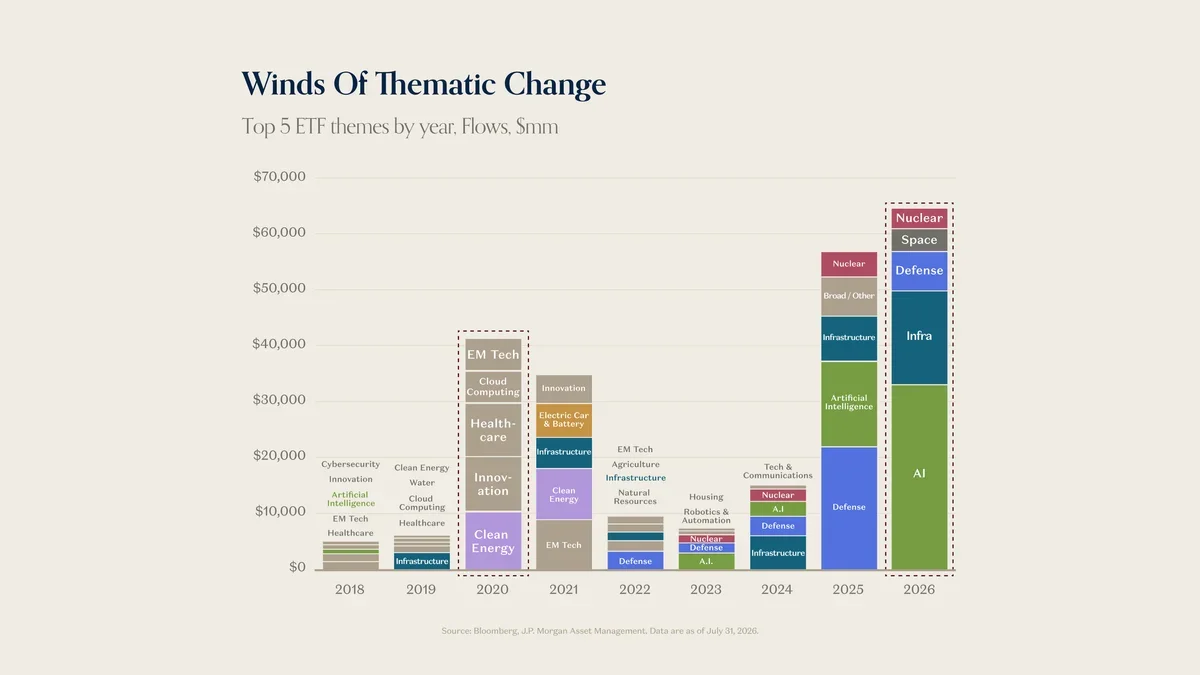
investor focus pivoted from clean energy to AI, nuclear, space, defense
Rideshare Fares ClimbEffect
AI agents' increased usage contributes to rising costs for human users
Capital-Intensive 'Atoms'Context
move towards industries requiring significant physical infrastructure investment
From the article 2 mentionsThis thematic evolution, as detailed in a recent a16z Blog analysis, highlights a clear move towards capital-intensive, 'atom'-focused industries.
Drivers BenefitOutcome
increased demand from AI agents potentially boosts earnings for human drivers
From the article 2 mentionsThe economic benefits extend beyond construction.
Data Center BoomDriver
construction represents 60% of non-residential building in some states
From the article 6 mentionsData centers, often a point of local contention, are proving to be a significant economic boon for the regions that host them.
Local Economic BoostOutcome
data centers significantly increase housing values, employment, and job growth
From the articleData centers, often a point of local contention, are proving to be a significant economic boon for the regions that host them.

The public market's fascination with Thematic ETFs has shifted dramatically. What was once dominated by clean energy and emerging market tech in 2020 has pivoted by 2026 to AI, nuclear, space, defense, and infrastructure. This thematic evolution, as detailed in a recent a16z Blog analysis, highlights a clear move towards capital-intensive, 'atom'-focused industries.

Meanwhile, the physical infrastructure supporting these new themes is seeing unprecedented economic impact. Data centers, often a point of local contention, are proving to be a significant economic boon for the regions that host them. In states like New Mexico and Wyoming, data center construction represents around 60% of all private non-residential building. Even in larger states such as Pennsylvania, data centers account for nearly 30% of such spending.

The economic benefits extend beyond construction. For counties with operational data centers, metrics like housing values, employment, and job growth have seen uniform improvement. While causality is complex, the wage premium offered by data center operations is undeniable. Skilled tradespeople, like concrete workers, can see wages jump by 50%, from $28-32 per hour to $45 per hour plus a per diem, a life-changing increase. This surge in demand is creating a blue-collar bonanza, making skilled trades increasingly lucrative.

Rideshare Costs Climb, Drivers Benefit

It’s not just infrastructure that’s changing. The cost of getting around is also on the rise. Ridesharing fares, particularly for Uber, have climbed by about 20% since the start of 2024, with median and average fares still trending upward. While Lyft rides remain cheaper overall, its fares are also beginning to increase after a period of decline. These fare hikes are directly benefiting both the platforms and the drivers, with average gross driver pay per trip reaching an all-time high.

The allure of gig work, bolstered by these increased earnings, is drawing more people into the sector. However, ridesharing is not the fastest-growing segment. Social commerce, essentially QVC for the social media age, has seen growth exceeding 30% among some consumer accounts. This boom could be fueled by shifting media consumption habits, the broader e-commerce surge, and potentially, AI's ability to lower operational costs for social media-based sales. This aligns with broader trends where AI is enabling new forms of commerce and advertising, as seen in AI's role in reshaping e-commerce and advertising.

AI Agents: The New Power Users

Within the rapidly expanding AI sector, a new class of power user is emerging: AI agents. While overall AI token output has doubled for typical firms, top-tier companies are seeing exponential growth, with some increasing output by over 17 times since April 2025. These power users are moving beyond simple chat interfaces, adopting advanced tools like plugins and skills at significantly higher rates than average firms.

The most striking development is the token consumption by AI agents themselves. Data from OpenRouter reveals that agents use nearly five times as many tokens as humans, and this usage has surged 14-fold since February. This phenomenon is driven by agents' iterative, goal-oriented processes, which heavily utilize cached tokens. This 'pre-fill' then incremental read-write cycle requires substantial memory, directly fueling the demand for high-bandwidth memory solutions. This evolution in AI usage also hints at a potential disruption for legacy automation tools like Zapier and N8N, which are seeing declining traffic, while AI-native agent builders like Gumloop gain traction.

For founders, the current wave of thematic investment and the burgeoning agent economy present distinct opportunities. Building in the 'atoms' sector, from data centers to advanced manufacturing, offers tangible economic impact and high-paying jobs. Simultaneously, developing tools and platforms that empower AI agents, or help enterprises navigate this new frontier of token consumption and advanced AI adoption, could capture significant value. The shift towards agents, while early, suggests a fundamental change in how AI is deployed and utilized, creating new markets and challenging existing ones.

© 2026 StartupHub.ai. All rights reserved. You may not republish this article in full without a license. Search engines and AI research tools may crawl and summarize for reference. Bulk reproduction or model training requires a license. See our terms.
Daniel Singer

Written by

Daniel Singer

Editor, StartupHub.ai

Daniel Singer is the editor of StartupHub.ai, a technology expert and thought leader on AI and its applications across sectors, from fintech and healthcare to developer tooling and consumer software. He writes and tests the tools covered here thoroughly and regularly, and built StartupHub.ai to give founders, operators and buyers a clearer read on what they are actually being sold.