

a16z Spotlights 'American Dynamism'

a16z's new film series spotlights Ulysses, Radiant, and Mariana Minerals, companies building foundational technologies in defense, energy, and materials, emphasizing government's role in deep tech.

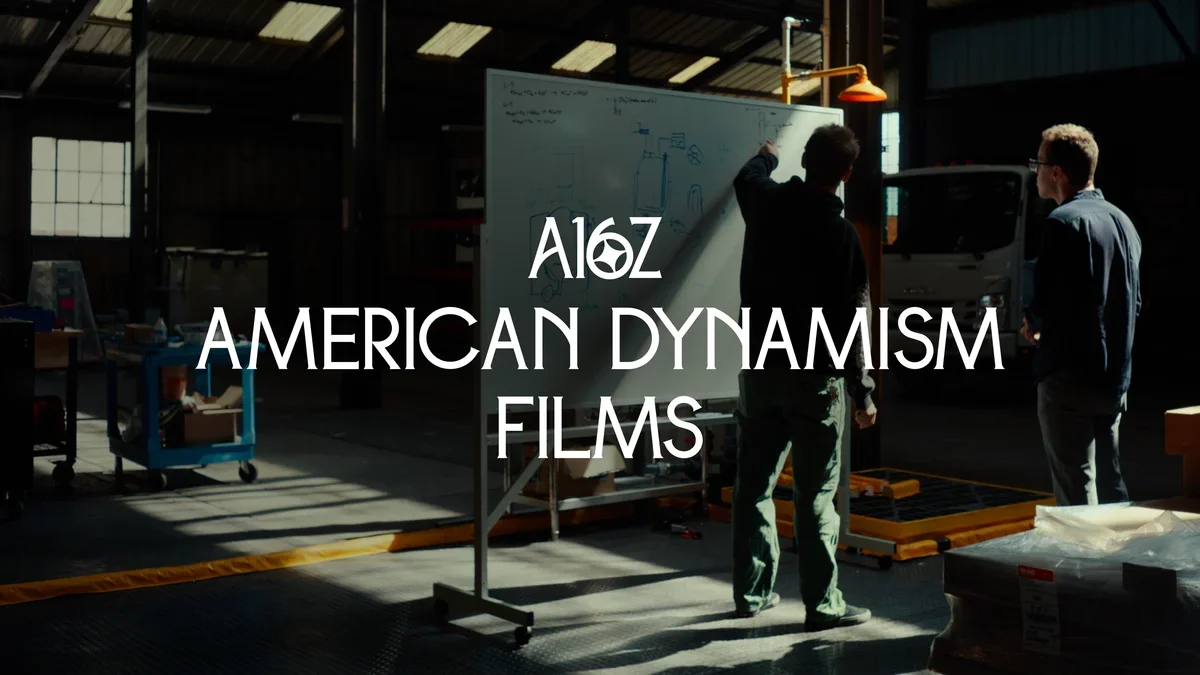
Screenshot from a16z's American Dynamism Film Series video montage.
a16z Blog
Visual TL;DR
a16z Film SeriesCore
Andreessen Horowitz launches 'American Dynamism Film Series' to spotlight foundational tech
From the article 3 mentionsVenture capital firm Andreessen Horowitz (a16z) has launched the "American Dynamism Film Series," a collection of short films spotlighting three companies poised to reshape critical sectors: defense, energy, and materials.
American DynamismContext
From the article 6 mentionsThe narrative centers on a renewed focus on "American Dynamism," a concept that champions building tangible, physical infrastructure and industries, moving beyond the purely digital.
Foundational TechCore
companies building foundational technologies in defense, energy, and materials
From the article 4 mentionsThe series, detailed on the a16z Blog, aims to showcase companies building foundational technologies that could redefine America's industrial and military capabilities.
UlyssesCore
company focused on maritime domain, addressing strategic shift in global conflict
From the article 2 mentionsThe first company featured is Ulysses, which is focused on the maritime domain.
RadiantCore
company building foundational technologies in energy, specifically splitting the atom
From the article 3 mentionsRadiant is tackling the energy sector with a radically different approach to nuclear power.
Mariana MineralsCore
company transforming earth, building foundational technologies in materials
From the article 3 mentionsThe third company, Mariana Minerals, is focused on revolutionizing the mining and refining industries through automation and AI.
Redefine CapabilitiesOutcome
From the article 3 mentionsThe series, detailed on the a16z Blog, aims to showcase companies building foundational technologies that could redefine America's industrial and military capabilities.
Contents(4)

Venture capital firm Andreessen Horowitz (a16z) has launched the "American Dynamism Film Series," a collection of short films spotlighting three companies poised to reshape critical sectors: defense, energy, and materials. The series, detailed on the a16z Blog, aims to showcase companies building foundational technologies that could redefine America's industrial and military capabilities.

The narrative centers on a renewed focus on "American Dynamism," a concept that champions building tangible, physical infrastructure and industries, moving beyond the purely digital. This contrasts with previous tech booms that often focused on software and internet services.

Securing the Seas: Ulysses

The first company featured is Ulysses, which is focused on the maritime domain. The series quotes Will O’Brien, suggesting a strategic shift in global conflict towards the oceans. "We have some periods in time that are defined by land, and this century we’re moving into a century that is defined by the sea," O’Brien states, predicting that future wars will be fought over oceans. This highlights a potential arms race in naval technology and underwater capabilities, a sector historically requiring significant government investment to mature.

The series draws a parallel to the Cold War space race, where massive government investment as a percentage of GDP accelerated technological timelines by decades. This historical precedent is used to frame the argument that government can act as an essential "anchor customer" for nascent, deep technologies, pulling them from research to deployment readiness. This model is presented as crucial for companies like Ulysses, which operate in sectors with long development cycles and high upfront costs.

Splitting the Atom: Radiant

Radiant is tackling the energy sector with a radically different approach to nuclear power. Instead of the traditional, multi-year, mega-project reactors, Radiant is developing modular nuclear reactors designed for rapid production and deployment. Doug Bernauer, speaking for the company, explains their ambition: "Our product is for off the grid, megawatt reactor on a trailer."

The company plans to manufacture reactors at a rate of one per week from their Tennessee facility. These units are designed to be transportable and operational within 48 hours of arrival at a customer's site. This "productized" approach to nuclear energy aims to decentralize power generation, offering reliable electricity to remote locations or areas with unstable grids. Bernauer emphasizes the fundamental role of electricity: "Electric power is civilization." This vision positions Radiant as a key player in modernizing energy infrastructure, making power accessible and scalable in ways previously unimagined.

Transforming the Earth: Mariana Minerals

The third company, Mariana Minerals, is focused on revolutionizing the mining and refining industries through automation and AI. Turner Caldwell from the company notes the inefficiencies in the current "full chain from mining all the way through refining," particularly the handoff points. Mariana Minerals is betting heavily on autonomy, using reinforcement learning to manage complex refining processes without human intervention.

The challenge of heterogeneous ore bodies requires constant adjustments to refinery parameters like temperature, flow rates, and chemical additions. Caldwell points out that the adoption of new technology in these plants is often limited by the operating teams' comfort with different tech stacks, which are frequently still pen and paper and numerous spreadsheets. Mariana Minerals aims to overcome this by embedding intelligence directly into the operational loop, making mining and refining more productive and efficient, especially when labor pools are constrained.

Why This Matters

The "American Dynamism Film Series" signals a significant trend: a renewed emphasis on tangible, industrial-scale innovation, often with a national security or strategic imperative. This is a departure from a decade dominated by software and digital platforms. The backing by a16z, a prominent Silicon Valley firm, suggests that venture capital is increasingly looking to fund companies that build physical products and infrastructure, requiring deep technical expertise and often substantial capital.

The series also highlights the enduring, and perhaps resurgent, role of government as a catalyst for advanced technology. The concept of the government acting as an anchor customer is critical for sectors like defense and advanced energy, where long development cycles and regulatory hurdles make private investment alone challenging. This aligns with broader geopolitical shifts, where national industrial capacity and technological sovereignty are gaining importance.

For the AI and startup world, this focus on "deep tech" and physical industries presents both opportunities and challenges. Companies developing AI for autonomous systems, materials science, and advanced manufacturing will find new avenues for investment and growth. However, these ventures often require longer timelines and different risk profiles compared to typical software startups. Investing in companies like these is a departure from the norm for many VCs. StartupHub.ai data indicates a low score of 3/100 for the "Investing" category itself, suggesting a general market caution. In comparison, competitors like TradingView (72/100), Bridgewise (61/100), and Boosted.ai (62/100) score higher in areas related to financial analysis tools, indicating where current AI investment tools are focused. The "American Dynamism" companies, however, represent a different, more hardware-intensive investment thesis.

The series implicitly raises questions about the future of American competitiveness. By focusing on companies that build, power, and defend the nation, a16z is betting on a future where tangible industrial might, augmented by advanced technology, is paramount. The success of these ventures could redefine the American economic and strategic posture in the coming decades.

© 2026 StartupHub.ai. All rights reserved. You may not republish this article in full without a license. Search engines and AI research tools may crawl and summarize for reference. Bulk reproduction or model training requires a license. See our terms.
Daniel Singer

Written by

Daniel Singer

Editor, StartupHub.ai

Daniel Singer is the editor of StartupHub.ai, a technology expert and thought leader on AI and its applications across sectors, from fintech and healthcare to developer tooling and consumer software. He writes and tests the tools covered here thoroughly and regularly, and built StartupHub.ai to give founders, operators and buyers a clearer read on what they are actually being sold.