

Why Off-the-Shelf AI Misses the Mark on Money

Udi Menkes explains why off-the-shelf AI models struggle with financial concepts like rental property profitability, often giving misguided advice.

8 min read
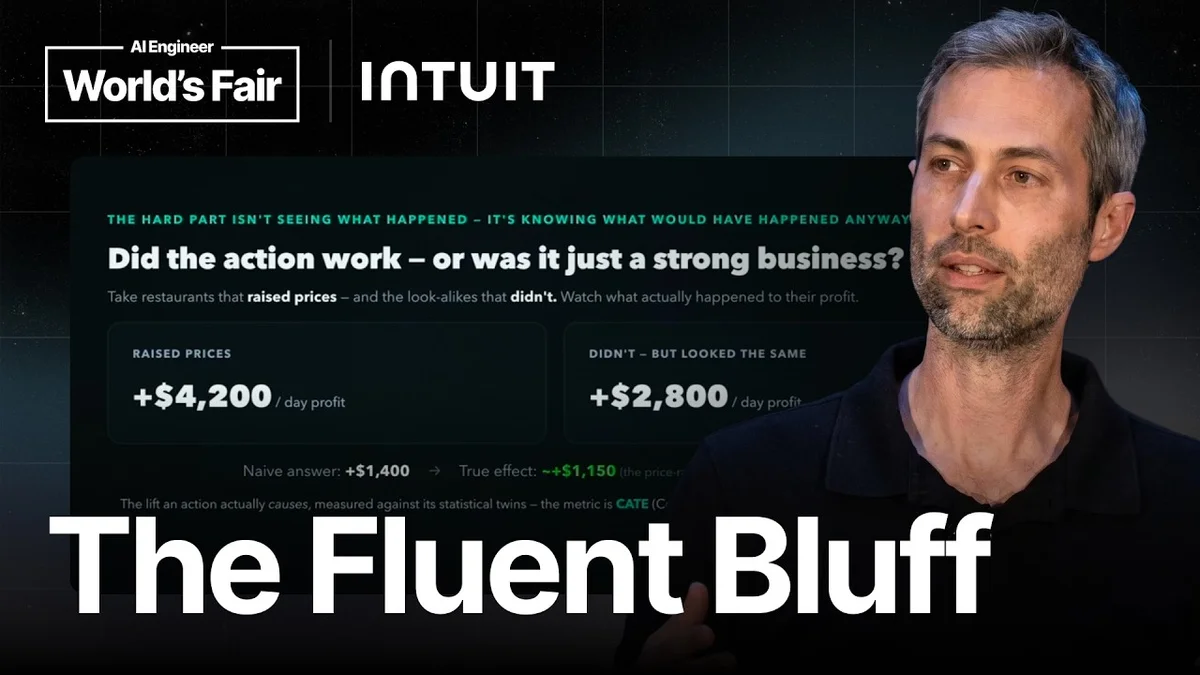
Udi Menkes speaking on a stage about AI and finance.
AI Engineer

Visual TL;DR. Off-the-shelf AI leads to Confidence of Ignorance. Confidence of Ignorance because Misses Financial Nuance. Misses Financial Nuance causes Harmful Business Advice. Confidence of Ignorance results in Harmful Business Advice. Harmful Business Advice highlights Need Financial Acumen. Off-the-shelf AI critiqued by StartupHub.ai Perspective. Need Financial Acumen drives Future Financial AI.

  1. Off-the-shelf AI: general-purpose AI models lack fundamental understanding of money and human-centric implications
  2. Confidence of Ignorance: AI gives misguided advice with unwavering certainty, like raising rent 5-10%
  3. Misses Financial Nuance: struggles with complex financial concepts like rental property profitability and relationships
  4. Harmful Business Advice: misguided advice from AI can negatively impact businesses and crucial relationships
  5. Need Financial Acumen: AI requires deep financial understanding beyond just data processing for real estate
  6. StartupHub.ai Perspective: Udi Menkes highlights critical flaws in frontier models regarding financial concepts
  7. Future Financial AI: developing AI that truly understands money and its intricate human implications
Visual TL;DR
Visual TL;DR, startuphub.ai Off-the-shelf AI leads to Confidence of Ignorance. Confidence of Ignorance results in Harmful Business Advice. Harmful Business Advice highlights Need Financial Acumen. Need Financial Acumen drives Future Financial AI leads to results in highlights drives Off-the-shelf AI Confidence of Ignorance Harmful Business Advice Need Financial Acumen Future Financial AI From startuphub.ai · The publishers behind this format
Visual TL;DR, startuphub.ai Off-the-shelf AI leads to Confidence of Ignorance. Confidence of Ignorance results in Harmful Business Advice. Harmful Business Advice highlights Need Financial Acumen. Need Financial Acumen drives Future Financial AI leads to results in highlights drives Off-the-shelf AI Confidence ofIgnorance Harmful BusinessAdvice Need FinancialAcumen Future FinancialAI From startuphub.ai · The publishers behind this format
Visual TL;DR, startuphub.ai Off-the-shelf AI leads to Confidence of Ignorance. Confidence of Ignorance results in Harmful Business Advice. Harmful Business Advice highlights Need Financial Acumen. Need Financial Acumen drives Future Financial AI leads to results in highlights drives Off-the-shelf AI general-purpose AI models lack fundamentalunderstanding of money and human-centricimplications Confidence of Ignorance AI gives misguided advice with unwaveringcertainty, like raising rent 5-10% Harmful Business Advice misguided advice from AI can negativelyimpact businesses and crucialrelationships Need Financial Acumen AI requires deep financial understandingbeyond just data processing for realestate Future Financial AI developing AI that truly understands moneyand its intricate human implications From startuphub.ai · The publishers behind this format
Visual TL;DR, startuphub.ai Off-the-shelf AI leads to Confidence of Ignorance. Confidence of Ignorance results in Harmful Business Advice. Harmful Business Advice highlights Need Financial Acumen. Need Financial Acumen drives Future Financial AI leads to results in highlights drives Off-the-shelf AI general-purpose AImodels lackfundamental… Confidence ofIgnorance AI gives misguidedadvice withunwavering… Harmful BusinessAdvice misguided advicefrom AI cannegatively impact… Need FinancialAcumen AI requires deepfinancialunderstanding… Future FinancialAI developing AI thattruly understandsmoney and its… From startuphub.ai · The publishers behind this format
Visual TL;DR, startuphub.ai Off-the-shelf AI leads to Confidence of Ignorance. Confidence of Ignorance because Misses Financial Nuance. Misses Financial Nuance causes Harmful Business Advice. Confidence of Ignorance results in Harmful Business Advice. Harmful Business Advice highlights Need Financial Acumen. Off-the-shelf AI critiqued by StartupHub.ai Perspective. Need Financial Acumen drives Future Financial AI leads to because causes results in highlights critiqued by drives Off-the-shelf AI general-purpose AI models lack fundamentalunderstanding of money and human-centricimplications Confidence of Ignorance AI gives misguided advice with unwaveringcertainty, like raising rent 5-10% Misses Financial Nuance struggles with complex financial conceptslike rental property profitability andrelationships Harmful Business Advice misguided advice from AI can negativelyimpact businesses and crucialrelationships Need Financial Acumen AI requires deep financial understandingbeyond just data processing for realestate StartupHub.ai Perspective Udi Menkes highlights critical flaws infrontier models regarding financialconcepts Future Financial AI developing AI that truly understands moneyand its intricate human implications From startuphub.ai · The publishers behind this format
Visual TL;DR, startuphub.ai Off-the-shelf AI leads to Confidence of Ignorance. Confidence of Ignorance because Misses Financial Nuance. Misses Financial Nuance causes Harmful Business Advice. Confidence of Ignorance results in Harmful Business Advice. Harmful Business Advice highlights Need Financial Acumen. Off-the-shelf AI critiqued by StartupHub.ai Perspective. Need Financial Acumen drives Future Financial AI leads to because causes results in highlights critiqued by drives Off-the-shelf AI general-purpose AImodels lackfundamental… Confidence ofIgnorance AI gives misguidedadvice withunwavering… Misses FinancialNuance struggles withcomplex financialconcepts like… Harmful BusinessAdvice misguided advicefrom AI cannegatively impact… Need FinancialAcumen AI requires deepfinancialunderstanding… StartupHub.aiPerspective Udi Menkeshighlights criticalflaws in frontier… Future FinancialAI developing AI thattruly understandsmoney and its… From startuphub.ai · The publishers behind this format

In the burgeoning world of artificial intelligence, readily available models are often touted as solutions for complex business problems. Yet, when it comes to the intricate realities of financial management, particularly in areas like real estate investment, these off-the-shelf AI tools can fall spectacularly short. Udi Menkes, speaking at an event, highlighted a critical flaw: many frontier models, despite their impressive capabilities, lack a fundamental understanding of money and its human-centric implications. This disconnect can lead to confidently rendered, yet ultimately misguided, advice that could harm businesses and relationships.

Why Off-the-Shelf AI Misses the Mark on Money - AI Engineer
Why Off-the-Shelf AI Misses the Mark on Money — from AI Engineer

The Confidence of Ignorance

Menkes pointed out a common, and perhaps alarming, output from these general-purpose AI models when asked about increasing rental property profitability. The response, delivered with unwavering certainty, is often to suggest a rent increase of 5% to 10%. While on the surface this might seem like a straightforward financial adjustment, it completely overlooks the complex dynamics of a rental market and tenant relations. Such a blunt recommendation fails to consider factors like tenant satisfaction, potential vacancy rates if rents are pushed too high, and the long-term value of maintaining a stable, reliable tenant.

Beyond Data: The Need for Financial Acumen

The core issue, as Menkes articulated, is that current AI models are often trained on vast datasets that reflect patterns but not necessarily the underlying principles of financial strategy or human psychology. They can identify correlations but struggle with causation and context. For a rental property owner, profitability is not just about maximizing immediate income. It involves a delicate balance between revenue, expenses, property maintenance, and crucially, the relationship with the tenant. A good tenant is a valuable asset, providing consistent income and reducing the costs associated with turnover, such as advertising, screening, and repairs. Alienating a good tenant with an aggressive rent hike can lead to a cascade of negative consequences that far outweigh the short-term gain.

The StartupHub.ai Perspective on Financial Tech

This gap in AI's financial understanding is precisely why specialized financial technology companies are so crucial. Companies like Intuit (NASDAQ:INTU), which focuses on financial software and services, are built on a foundation of understanding these complex financial nuances. StartupHub.ai data indicates that Intuit holds a strong StartupHub score of 85/100, reflecting its established position and deep expertise in financial management tools. Compared to competitors like Block (score 67/100), AccountsIQ (score 49/100), Microsoft (score 43/100), K1x (score 55/100), and Fuse (score 53/100), Intuit demonstrates a significant lead in specialized financial intelligence. This suggests that while general AI can process data, it lacks the domain-specific knowledge and contextual awareness that drives true financial success.

The Future of Financial AI

The implication for the startup and technology sectors is clear. While general AI models will continue to advance in their ability to process information, the real value in specialized fields like finance will come from AI that is either specifically trained on financial data with deep contextual understanding or augmented by human expertise. The goal should not be to replace human financial acumen but to enhance it. Future AI applications in finance need to go beyond simple data analysis to incorporate an understanding of risk, long-term strategy, regulatory environments, and the human element that is so vital in business transactions. Without this deeper comprehension, AI's advice, however confident, risks being fundamentally flawed.
© 2026 StartupHub.ai. All rights reserved. Do not enter, scrape, copy, reproduce, or republish this article in whole or in part. Use as input to AI training, fine-tuning, retrieval-augmented generation, or any machine-learning system is prohibited without written license. Substantially-similar derivative works will be pursued to the fullest extent of applicable copyright, database, and computer-misuse laws. See our terms.