


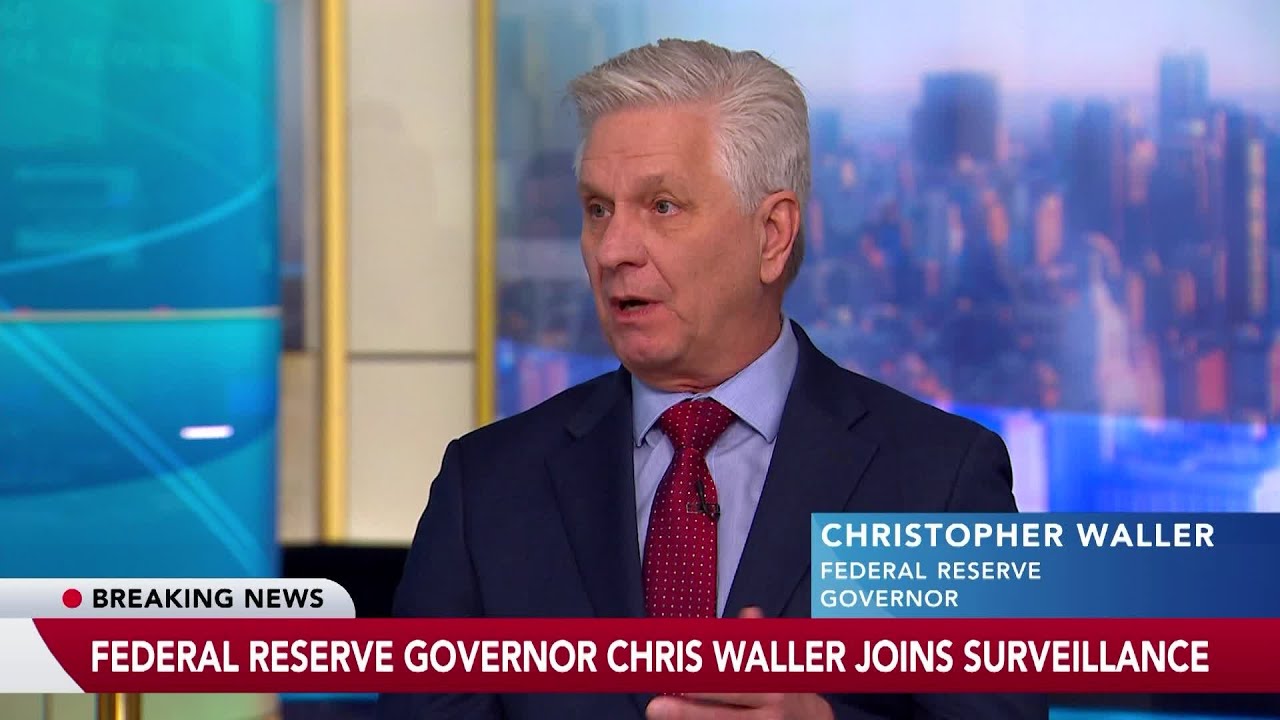
Federal Reserve Governor Christopher Waller recently shared insights on the U.S. economy, particularly its labor market and inflation outlook, during an appearance on Bloomberg Surveillance. His comments provided a snapshot of the Fed's current thinking and potential policy responses to evolving economic conditions.
Christopher Waller's Perspective
Christopher Waller, a member of the Federal Reserve's Board of Governors, is a key voice in shaping U.S. monetary policy. His background includes extensive experience in economics, with prior roles as a professor and a researcher at the Federal Reserve Bank of St. Louis. Waller is known for his data-driven approach and his focus on the dual mandate of the Federal Reserve: maximizing employment and maintaining price stability.
Labor Market Resilience and Potential Easing
A central theme of Waller's discussion was the current strength of the U.S. labor market. He acknowledged that while the economy has shown resilience, the Fed remains vigilant about potential shifts. Waller stated that if the labor market were to show significant signs of weakness, such as a substantial slowdown in job growth or an increase in unemployment, the Federal Reserve would be inclined to consider easing its monetary policy stance. He specifically mentioned that a "solid jobs number" would allow the Fed to "sit and wait" on further tightening, implying that such data would indicate that current policy is sufficient to manage inflation without unduly harming employment.
The full discussion can be found on Bloomberg Podcast's YouTube channel.
Impact of Energy Prices on Inflation
The conversation also delved into the persistent influence of energy prices on inflation. Waller drew a parallel to the 1970s, a period marked by sustained inflation driven by oil price shocks. He suggested that while current supply chain issues are resolving, significant and prolonged spikes in energy prices could still pose a risk to inflation. However, he differentiated between temporary price increases and those that could lead to a broader, more persistent inflationary trend. Waller emphasized that the Fed's focus is on whether these price movements translate into broader price pressures across the economy, particularly in core inflation measures that exclude volatile energy and food prices.