

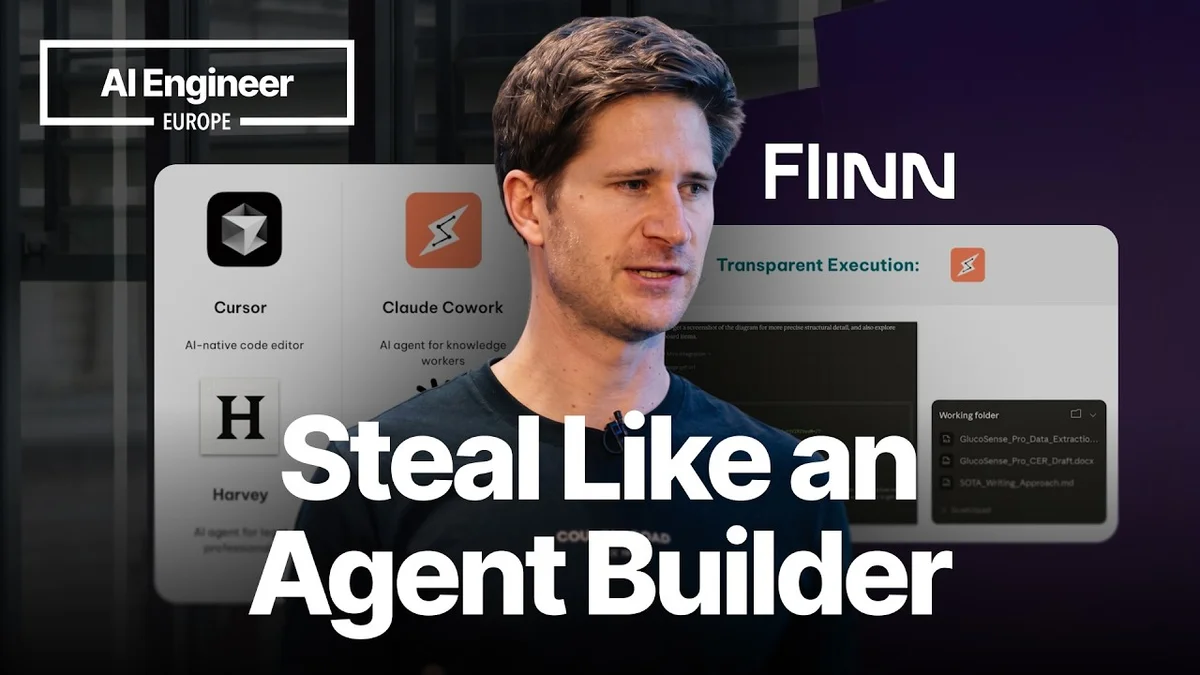
Mardu Swanepoel on AI Agent Best Practices

Mardu Swanepoel of Flinn AI outlines the four core traits of top AI agents: focused modes, transparent execution, personalization, and reversibility.

Mardu Swanepoel presenting on AI agent best practices at AI Engineer Europe.
AI Engineer
Visual TL;DR
AI Agent Best PracticesCore
Mardu Swanepoel of Flinn AI shares insights on top AI agents
From the articleBy "stealing" these best practices, developers can engineer more effective and reliable AI solutions.
Four Core TraitsContext
Key patterns observed in high-performing AI agents
From the articleSwanepoel articulated that the most successful agents share four key traits: focused modes, transparent execution, personalization, and reversibility.
Focused ModesContext
From the article 2 mentionsFocused Modes: These agents operate within a "constrained scope for dedicated tasks." By narrowing the agent's focus, the output quality for specific functions is improved.
Transparent ExecutionContext
Understanding how the agent operates and its decision-making
From the article 2 mentionsTransparent Execution: The principle here is to "make every step the agent takes visible." This transparency is crucial for building user trust, allowing them to understand the agent's reasoning and actions.
PersonalizationContext
Tailoring agent behavior to individual user needs and preferences
From the article 2 mentionsPersonalization: This involves tailoring agent outputs to "user conventions, preferences, etc." Swanepoel emphasized that personalization significantly increases the "speed to understanding" for users.
ReversibilityContext
Ability to undo or correct agent actions easily
From the article 2 mentionsReversibility: The final key trait is the ability for "every agent action to be easily undone." This feature binds the cost of mistakes, making users bolder and more willing to take risks with AI tools.
High-Performing AgentsOutcome
Achieving superior results and user satisfaction
From the article 9+ mentionsIn a presentation at AI Engineer Europe, Mardu Swanepoel of Flinn AI shared insights into the core characteristics that define effective AI agents.
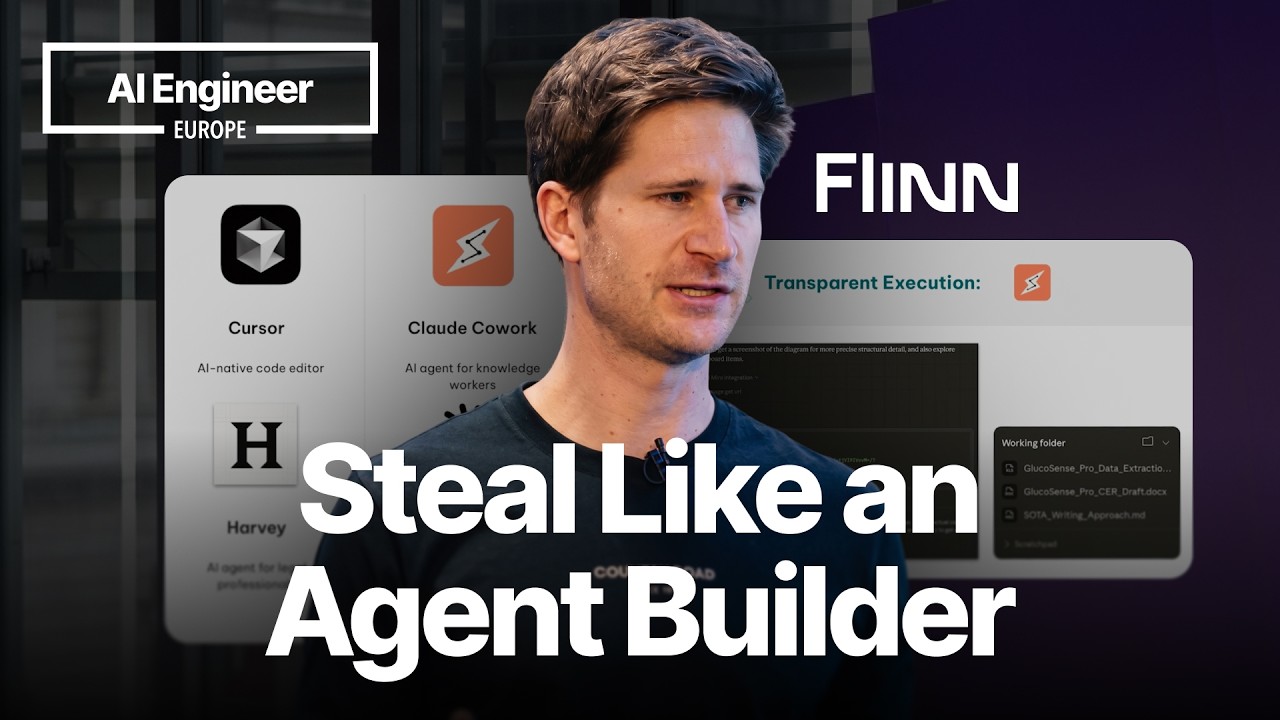
In a presentation at AI Engineer Europe, Mardu Swanepoel of Flinn AI shared insights into the core characteristics that define effective AI agents. Swanepoel articulated that the most successful agents share four key traits: focused modes, transparent execution, personalization, and reversibility.

StartupHub data

Companies working on this

Profiles of the companies named in this story, with funding and a one-liner from our database.

Cursor
$50.0B
An AI-native code editor that helps developers write, understand, and manage code more efficiently.
Mardu Swanepoel on AI Agent Best Practices - AI Engineer
Mardu Swanepoel on AI Agent Best Practices, from AI Engineer

The Pillars of High-Performing AI Agents

Swanepoel began by referencing a Pablo Picasso quote, "Good artists copy, great artists steal," to illustrate his point about learning from existing successes. He explained that "stealing" in this context means deeply understanding and integrating effective strategies into new creations, rather than simple imitation.

He then outlined the four key patterns observed in top-tier AI agents:

  • Focused Modes: These agents operate within a "constrained scope for dedicated tasks." By narrowing the agent's focus, the output quality for specific functions is improved. This approach guides the user's expectations by clearly defining what the agent is designed to do. Examples shown included agents for coding (Cursor), knowledge workers (Claude Cowork), and legal professionals (Harvey).
  • Transparent Execution: The principle here is to "make every step the agent takes visible." This transparency is crucial for building user trust, allowing them to understand the agent's reasoning and actions. Tools like Claude Cowork were highlighted for their ability to show progress and the context of their operations, enabling users to intervene if necessary.
  • Personalization: This involves tailoring agent outputs to "user conventions, preferences, etc." Swanepoel emphasized that personalization significantly increases the "speed to understanding" for users. Agents that effectively incorporate user preferences and context are more likely to produce relevant and useful results, avoiding the pitfalls of generic outputs. Harvey's playbook system for legal firms was cited as an example of this.
  • Reversibility: The final key trait is the ability for "every agent action to be easily undone." This feature binds the cost of mistakes, making users bolder and more willing to take risks with AI tools. By allowing users to easily revert actions, agents can provide a safer environment for experimentation and learning, ultimately leading to more efficient problem-solving. Swanepoel demonstrated this with Cursor's ability to undo changes at a granular level.

Swanepoel concluded by stressing that these four principles are fundamental to building AI agents that are not only functional but also trustworthy and user-centric. By "stealing" these best practices, developers can engineer more effective and reliable AI solutions.

© 2026 StartupHub.ai. All rights reserved. You may not republish this article in full without a license. Search engines and AI research tools may crawl and summarize for reference. Bulk reproduction or model training requires a license. See our terms.
Daniel Singer

Written by

Daniel Singer

Editor, StartupHub.ai

Daniel Singer is the editor of StartupHub.ai, a technology expert and thought leader on AI and its applications across sectors, from fintech and healthcare to developer tooling and consumer software. He writes and tests the tools covered here thoroughly and regularly, and built StartupHub.ai to give founders, operators and buyers a clearer read on what they are actually being sold.

More from Daniel Singer