


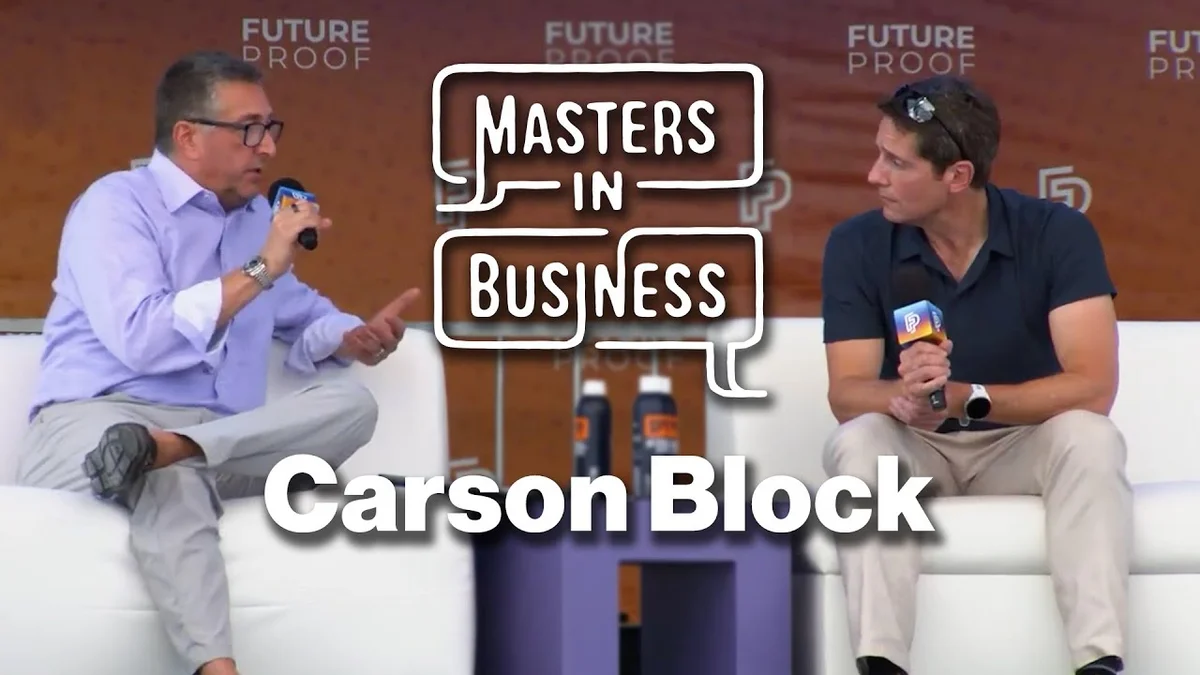
Barry Ritholtz, author and host of the Masters in Business podcast, recently sat down with Carson Block, founder and CEO of Muddy Waters Research. Block, a prominent short-seller known for his deep dives into corporate malfeasance, shared insights into his career path and his views on the evolving financial markets, particularly concerning the role of artificial intelligence.
Carson Block's Journey into activist short selling
Block's initial exposure to the financial world came through his father, an equity analyst. This early immersion, coupled with his experiences in China during the early 2000s, where he observed what he describes as a market "riddled with financial predators," shaped his career trajectory. He recounted how, around 2002, he realized the necessity of developing tools to protect himself and others from deceptive financial practices. This led him to pursue a law degree, hoping to gain a better understanding of legal frameworks, and eventually to China, where he founded a self-storage business before pivoting to his now-famous short-selling endeavors.
The Rise of AI and Its Impact on Markets
The conversation touched upon the increasing sophistication of AI and its potential impact on financial analysis and short selling. Block expressed a nuanced view, acknowledging AI's utility in processing vast amounts of data but also cautioning against its potential misuse. He noted that while AI can identify patterns and anomalies that human analysts might miss, it can also be exploited to generate sophisticated misinformation. This, he believes, necessitates a more critical approach to data and a deeper understanding of the underlying fundamentals, rather than blindly trusting AI-generated insights.
The full discussion can be found on Bloomberg Podcast's YouTube channel.
Block drew parallels between the current AI boom and past market phenomena, such as the dot-com bubble, highlighting the cyclical nature of investor enthusiasm and the potential for overvaluation. He emphasized that while AI can be a powerful tool, it does not replace the need for rigorous due diligence and critical thinking. The ability to discern between genuine innovation and speculative hype remains paramount for investors and analysts alike.