

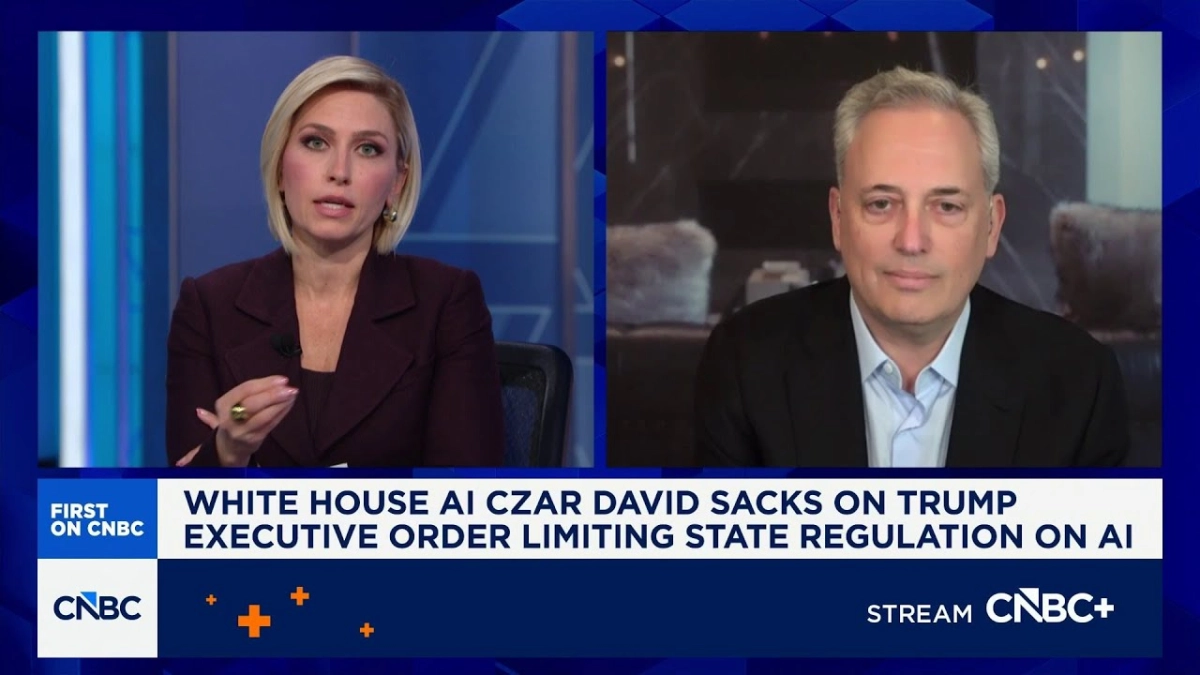
The rapid acceleration of artificial intelligence has ignited a multifaceted debate spanning innovation, national security, and economic impact, a tension vividly explored in a recent CNBC “Closing Bell Overtime” interview. David Sacks, the White House AI and Crypto Czar, spoke with Morgan Brennan about President Trump’s executive order aiming to streamline AI regulation, the intensifying AI race with China, and the nuanced reality of AI’s effect on the American workforce. His commentary offered a window into the administration’s strategy: fostering an environment conducive to technological leadership while prudently addressing emerging challenges.
At the heart of the administration's domestic AI policy lies a clear objective: to prevent a fragmented regulatory landscape. Sacks highlighted the current predicament where "50 different states are running in 50 different directions with AI regulation," with "a thousand bills right now going through state legislatures." This burgeoning "patchwork" of regulations, he argued, creates an onerous compliance burden, particularly for "small startups and innovators," threatening to stifle the very innovation the U.S. seeks to lead. The executive order, therefore, calls for a "single national or federal framework for AI regulation" to ensure ease of compliance and maintain the nation's competitive edge in the global AI race. While critics question the executive branch's authority to assert such power, Sacks clarified that the EO provides a "statement of principles" and "tools to allow the federal government to push back on the most onerous and excessive state regulations," ultimately tasking the administration to work with Congress to define and enact this overarching federal framework.
Beyond domestic concerns, the interview underscored the pressing geopolitical dimension of AI. Brennan raised the specter of an "AI arms race with China," a notion Sacks readily affirmed, though he expanded its scope beyond weaponry to include economic dominance. "AI is going to power the economies of the 21st century," he asserted, emphasizing the imperative for the U.S. to remain "globally competitive." Strikingly, Sacks identified a critical vulnerability: American optimism. He cited data indicating that 83% of people in China are optimistic about AI, compared to only 39% in the U.S. This "optimism gap," Sacks suggested, is the primary area requiring intervention, urging a cultural shift to embrace the potential of AI rather than succumbing to fear.
The discussion naturally pivoted to the strategic control of advanced technology, specifically Nvidia’s chip exports to China. The administration’s policy, Sacks explained, differentiates between "lagging chips" and "leading-edge" technology, permitting the export of the former but restricting the latter to prevent China from gaining a military or technological advantage. This distinction is constantly debated, as the pace of innovation quickly renders once leading-edge technology obsolete.
Sacks noted that the H200, once a leading chip, is now considered a previous generation and therefore acceptable for export. However, he also pointed out that China, driven by its ambition to achieve "semiconductor independent," appears to be declining these U.S. chips, signaling a long-term strategic play to develop its own indigenous capabilities.