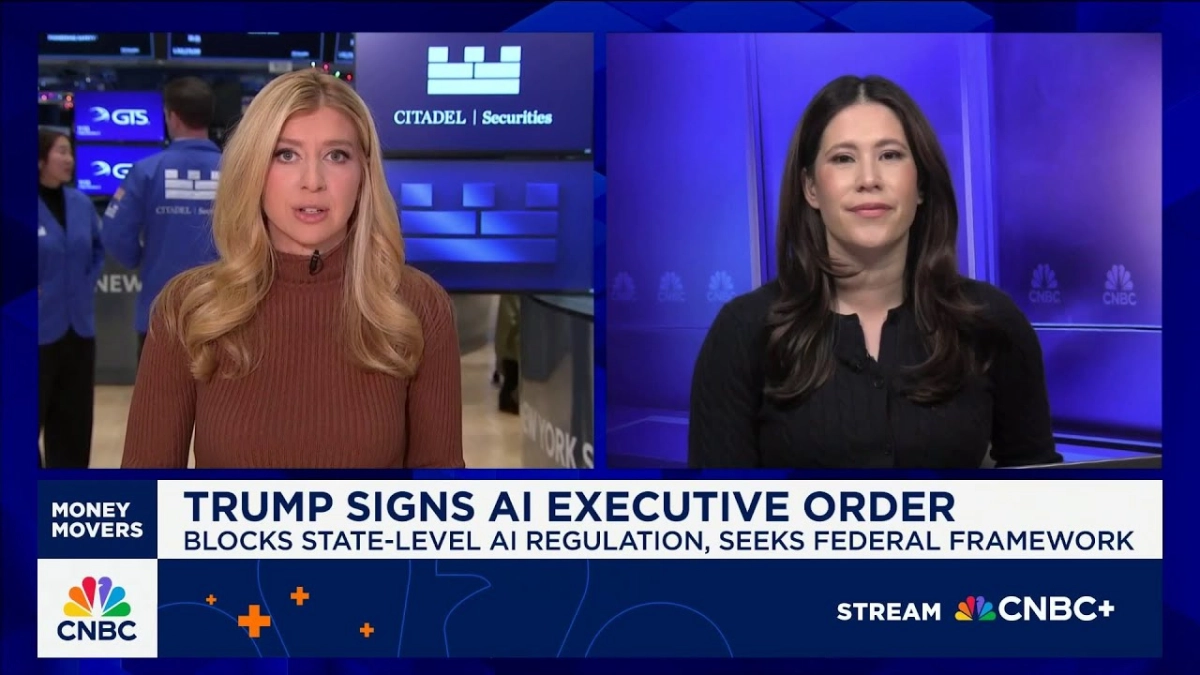
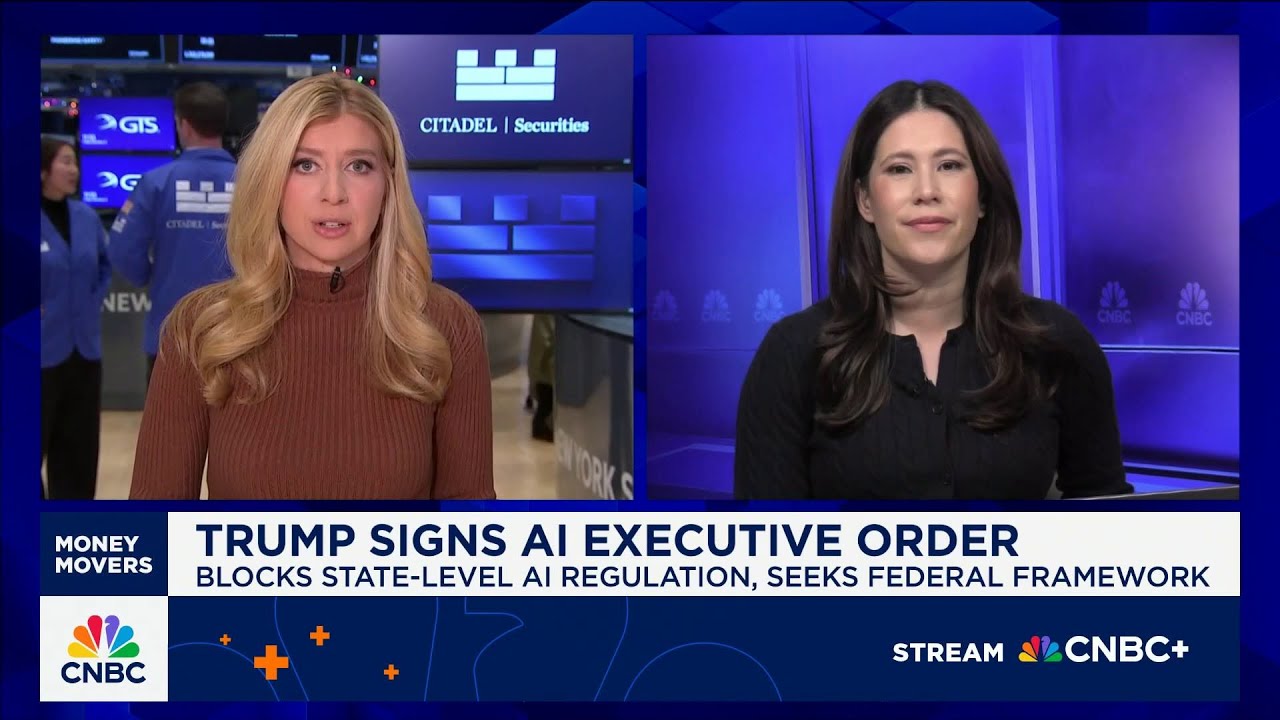
The global race for artificial intelligence dominance is not merely a contest of technological prowess, but increasingly, a strategic divergence in regulatory philosophy, with profound implications for innovation, safety, and international leadership. On a recent segment of CNBC's 'Money Movers,' TechCheck Anchor Deirdre Bosa reported on President Trump’s executive order concerning artificial intelligence, engaging in a discussion with the show's hosts about its immediate effects and broader geopolitical ramifications. The order aims to establish a unified national AI framework, explicitly blocking states from enacting their own regulations, a move intended to accelerate American innovation in the face of burgeoning competition from China.
This executive order reflects a prevailing sentiment within the US tech industry: that speed and innovation are paramount to maintaining global leadership in AI. Deirdre Bosa articulated this perspective, noting, "this new order reflects something that I do hear a lot behind the scenes from investors and founders, and that is that the U.S. is better off competing with China, out-innovating, rather than arguing about regulation." This stance suggests a belief that a fragmented regulatory landscape, with individual states imposing diverse rules, would stifle development and cede ground to international rivals. The creation of a single national framework is therefore seen as a strategic imperative to reduce friction and streamline deployment for companies operating across state lines, allowing them to focus resources on development rather than navigating a complex web of varying compliance requirements.
In stark contrast to the US emphasis on unburdened innovation, China has positioned AI safety as a core national priority, intertwining it with its aggressive push for technological advancement. Bosa highlighted this critical distinction, stating, "Beijing actually has made AI safety a political priority. From pre-deployment safety reviews to clearing thousands of non-compliant AI products from the market." This proactive regulatory stance in China, including rigorous pre-deployment safety reviews and the removal of non-compliant products, demonstrates a willingness to control the pace and nature of AI development to ensure alignment with national objectives. It is a calculated move to consolidate power while simultaneously ensuring controlled acceleration, a nuanced strategy often overlooked by Western observers who might perceive regulation solely as a hindrance.
The US approach, while lauded by many in the tech sector for fostering an environment conducive to rapid iteration, carries inherent risks. By treating regulation itself as a potential threat to innovation, the US risks overlooking critical safety and ethical considerations that could ultimately undermine public trust and long-term adoption. This internal struggle over regulatory jurisdiction, exemplified by potential conflicts between the federal order and state attorneys general, could create the very friction the order seeks to prevent. One host posed a pertinent question, reflecting the industry's frustration: "why would we spend the next few years fighting California and Colorado over model disclosures when China is simply pouring billions into its industry and propping up demand?" This encapsulates the fear that internal bickering will distract from the larger geopolitical competition, where unified national strategies are perceived as more effective.
The core strategic difference lies in whether AI development should be maximally accelerated or carefully controlled. The implications of this divergence are substantial.
While American ingenuity might produce the "Lamborghinis" of AI, highly advanced, cutting-edge systems for specialized applications, China appears focused on building the "Priuses", safe, reliable, and widely adopted systems that could become the global standard. This mass-market adoption strategy, underpinned by a robust regulatory framework focused on safety and control, could allow China to establish the foundational AI infrastructure that the rest of the world builds upon. Such a scenario would grant China significant influence over global AI norms, data governance, and ethical standards, even if its individual innovations aren't always at the bleeding edge. The long-term impact of such a divergence could be profound, influencing everything from data governance to ethical norms and even geopolitical influence.
The US strategy implicitly trusts market forces and industry self-regulation to address safety concerns, believing that competition will naturally drive responsible development. However, this hands-off approach could lead to a patchwork of voluntary guidelines rather than a coherent, enforceable standard, leaving the door open for inconsistent application and potential gaps in oversight. The video underscored that even within the US, AI safety is not a partisan issue, with various states likely to pursue their own regulatory agendas, further complicating the federal government's ambition for a unified voice. The practical challenges of reconciling diverse state interests with a singular federal mandate for AI regulation are immense, potentially leading to prolonged legal battles and policy uncertainty.
Deirdre Bosa concluded with a pivotal question that should resonate deeply within the tech and policy communities: "The question now, guys, is whether the US can get to a coherent national framework, or whether it spends the next few years tied up internally while China builds and does so with safety top of mind." This captures the essence of the current dilemma. The US risks internal fragmentation while China, with its centralized authority, moves decisively to not only innovate but also to embed safety and control into its AI ecosystem from the ground up. This approach, while potentially less "free-market" in spirit, could ultimately lead to greater global adoption and influence if it yields more reliable and trustworthy AI systems, making China a de facto standard-setter in critical areas of AI deployment.