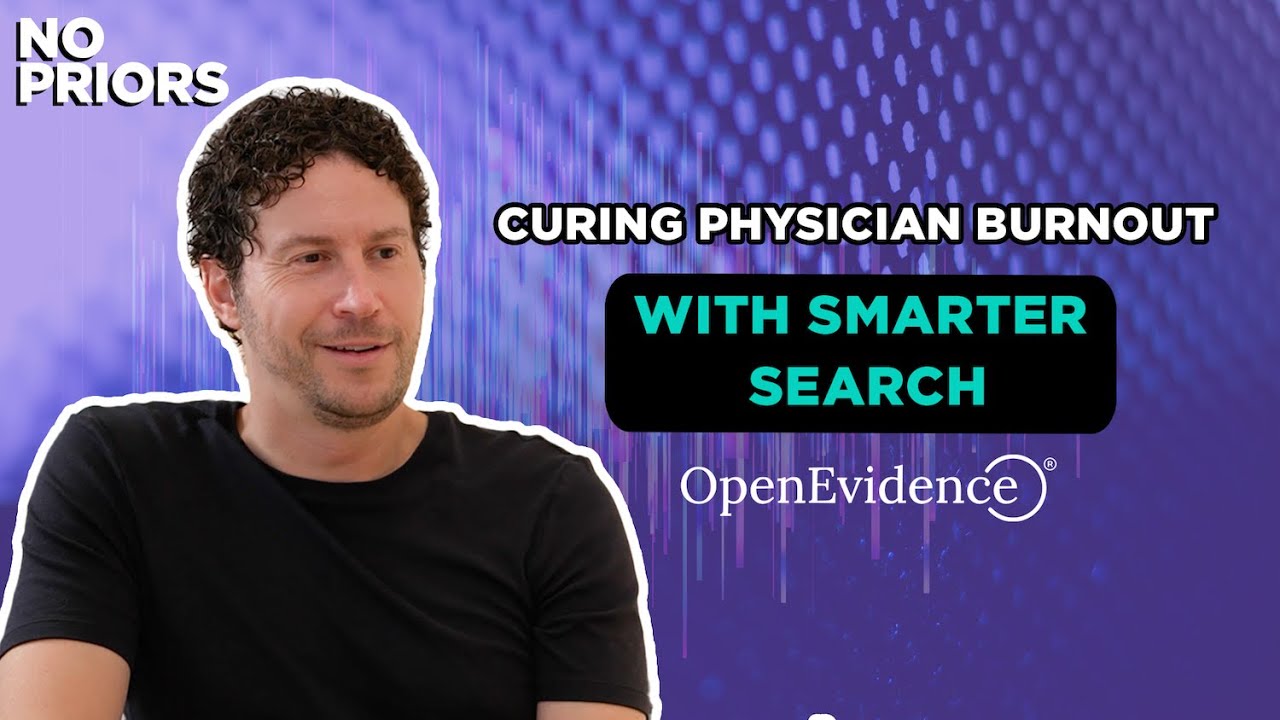
In a recent episode of the No Priors podcast, hosts Sarah Guo and Elad Gil engaged with Daniel Nadler, founder of OpenEvidence, about his company's meteoric rise. OpenEvidence has achieved remarkable adoption, now serving 40% of American doctors within just 18 months, becoming what Nadler describes as "the operating system for clinical knowledge in the United States." This rapid integration highlights a significant shift in how AI-driven solutions are being embraced by critical knowledge-worker professions.

At its core, OpenEvidence tackles the profoundly complex "semantic search problem" inherent in medical decision-making. Unlike simple keyword searches, doctors require an understanding of nuanced clinical contexts. Nadler illustrates this with a compelling example: "You have a 44-year-old female patient, she has moderate to severe psoriasis… Except she has MS."
This scenario demands an intricate knowledge of drug interactions across specialties to avoid aggravating the multiple sclerosis while treating psoriasis, a distinction that traditional search or even human memory struggles to maintain given the explosion of new medical knowledge. Nadler's pivotal insight was to treat doctors not as institutional appendages, but as discerning consumers. He consciously built "a consumer internet company masquerading as a healthcare company," recognizing that knowledge workers, whether on Wall Street or in the clinic, seek intuitive, efficient tools they own and control. By offering a free, accessible platform, OpenEvidence bypassed traditional, cumbersome enterprise adoption cycles, focusing instead on user experience and direct value delivery.
This consumer-centric approach directly addresses the "dark ages of physician burnout," a consequence of the "golden age of biotechnology" where medical knowledge doubles at an astonishing rate. Doctors are overwhelmed by the sheer volume of new drugs and treatment protocols. OpenEvidence doesn't provide definitive answers, a crucial distinction; instead, it functions as a sophisticated "search engine," routing physicians to the exact snippets of peer-reviewed literature and clinical trials they need, complete with citations for auditing. This commitment to verifiable, source-backed information builds indispensable trust, transforming a chaotic information landscape into an actionable one.
OpenEvidence's success stems from a potent combination of factors: identifying a critical, high-stakes pain point, leveraging advanced semantic AI, and adopting a consumer-first distribution model. By empowering individual practitioners with readily available, highly relevant, and auditable clinical intelligence, the company has not only multiplied physician productivity but also significantly reduced the potential for medical errors, fundamentally reshaping how medical knowledge is accessed and applied.