

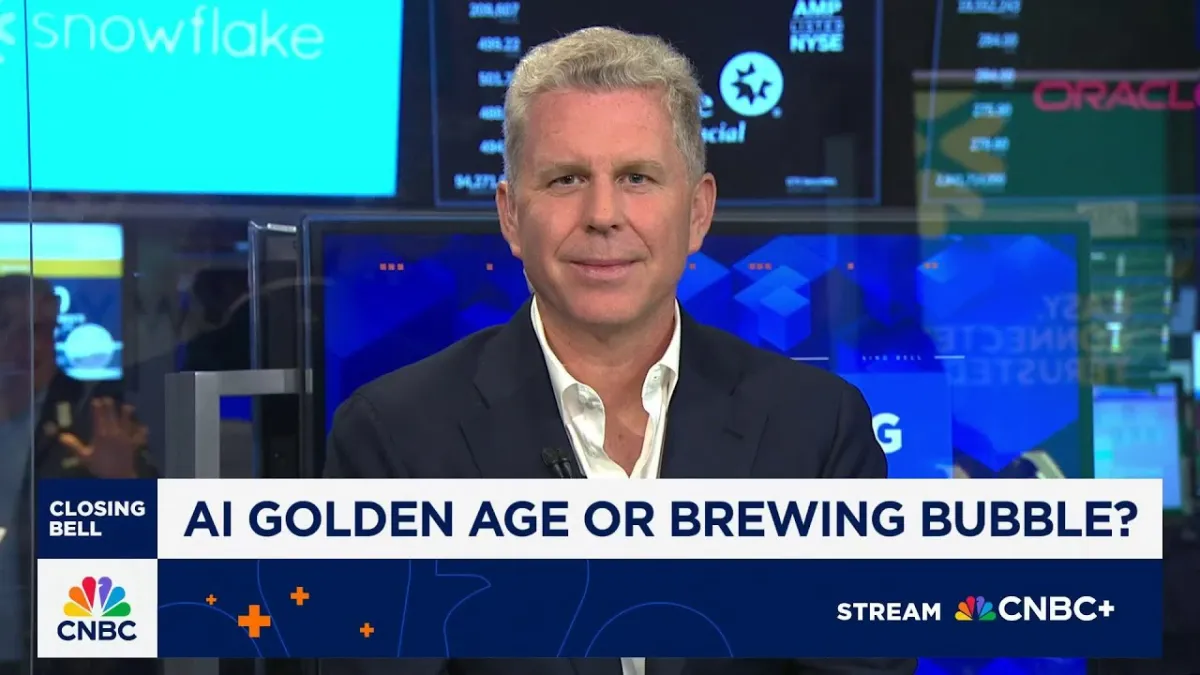
"Capital expenditure, you don't know until it's way too late," cautioned Rick Heitzmann, FirstMark Capital founder and partner, during a recent discussion on CNBC's 'Closing Bell.' Heitzmann, a veteran venture capitalist with investments spanning Pinterest, Airbnb, and DraftKings, joined Scott Wapner to dissect the escalating AI trade, drawing pointed parallels to the dot-com bubble and the railroad boom. The central question: Is the current surge in AI investment a golden age of innovation or a bubble brewing, destined for a painful deflation?
Heitzmann's analysis began by acknowledging the familiar historical echoes. Like the internet infrastructure buildout of the late 90s or the railroad expansion a century prior, the AI sector is witnessing an "unstoppable CapEx" cycle. Companies are pouring vast sums into computational power, data centers, and specialized hardware, driven by the promise of transformative AI capabilities. This unbridled spending, Heitzmann notes, shares a critical characteristic with previous speculative frenzies: the inherent difficulty in assessing ROI until commitments are deeply entrenched.
However, a significant distinction emerges in the funding mechanism. Unlike the dot-com era, where many ventures relied heavily on external capital markets, today's hyperscalers, the likes of Google, Meta, and others, are largely self-funding their AI ambitions through robust existing earnings. This internal capital generation provides a buffer, suggesting a different trajectory for any eventual market correction.
This financial self-sufficiency means a market correction, if it comes, might manifest as a slow deflation rather than a sudden burst.
The prevailing sentiment, Heitzmann observes, is that AI has entered a crucial "prove it" phase. While the initial excitement and speculative investments were understandable, the market is now demanding tangible returns on the colossal capital outlays. He suggests the AI spending cycle is likely in its "third inning," implying a substantial portion of the infrastructure investment has already occurred, setting the stage for the realization of promised benefits. The challenge lies in ensuring these long-term commitments, some stretching for decades, ultimately yield the expected medium-term ROI.