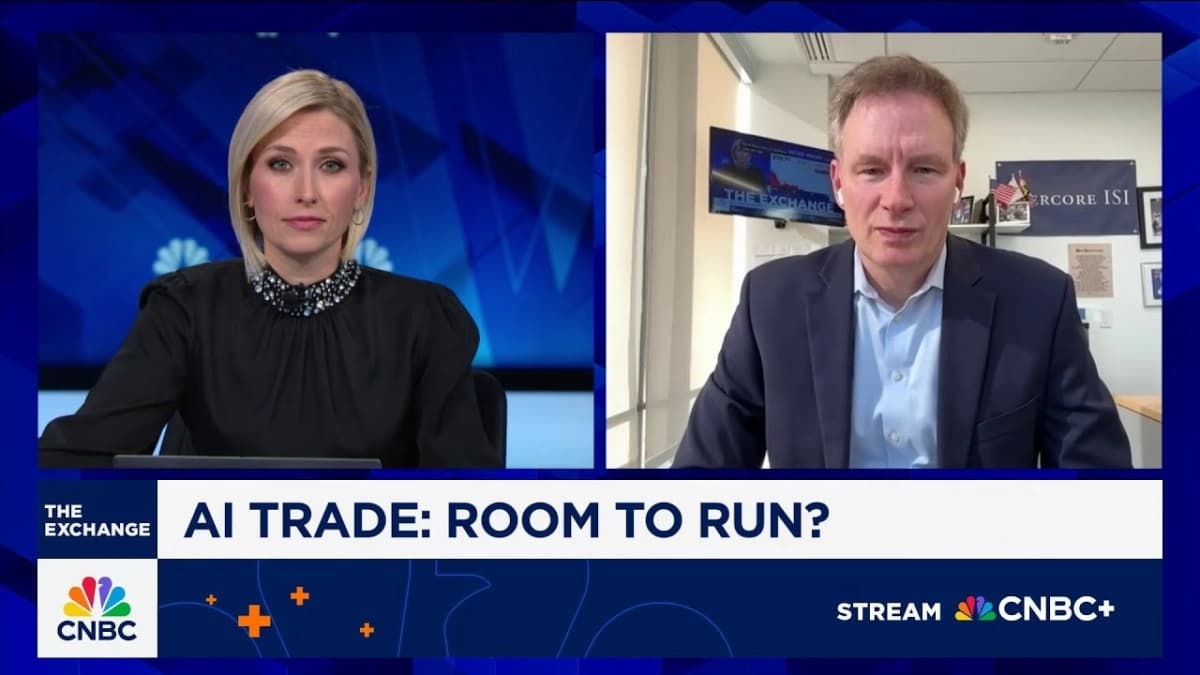
The market narrative surrounding artificial intelligence investment has matured from initial concerns over excessive capital expenditure to a recognition of tangible returns, according to Mark Mahaney, Evercore ISI's Head of Internet Research. Mahaney articulated this evolving perspective on CNBC's "The Exchange," emphasizing that companies are beginning to demonstrate a clear "Return on AI Investment" (ROAI), which is driving productivity gains and influencing stock performance.
Mark Mahaney, Evercore ISI head of internet research, spoke with Morgan Brennan on "The Exchange" about the latest earnings season, the AI trade, and specific tech stock opportunities. His commentary centered on the financial implications of AI investments by hyper-scalers and the broader health of consumer demand.
A pivotal insight from Mahaney is the shift in investor sentiment regarding the substantial CapEx spending by tech giants like Amazon, Google, and Meta. Initially, there was apprehension that these companies were overspending, but recent earnings have revealed that these investments are translating into measurable benefits. Mahaney coined the term "ROAI" to describe this phenomenon, noting that "tech names [are] showing rising ROAI – Amazon, Google, Meta," evident in their revenue and operating income per employee. This indicates that generative AI is not merely a buzzword but "a very powerful product cycle" that is actively enhancing efficiency and profitability.
Amazon, in particular, stands out as Mahaney's top pick, largely due to the renewed strength and clarity around its Amazon Web Services (AWS) division. For a period, AWS's growth trajectory was uncertain, but recent performance has provided a decisive "unlock." Mahaney stated, "You just got the unlock from AWS, you finally got this thing above 20% and that growth could get better than that next year." This re-acceleration in cloud growth, fueled by AI demand, solidifies Amazon's position as a foundational AI infrastructure provider. Beyond AWS, Amazon's retail business is also benefiting from AI-driven automation and robotization, leading to improved operating margins.
Beyond the core business, Amazon is also poised for growth from nascent, high-potential ventures. Project Kuiper, Amazon's satellite internet initiative, represents a significant long-term opportunity. Mahaney believes that "Starlink has proven that this is a big opportunity," and Amazon is well-positioned to participate in the burgeoning commercial satellite internet market, with substantial investments expected to come online by 2026. This diversification into new product categories further bolsters Amazon's appeal as an AI winner.
While Amazon is a clear leader, other tech players present different investment profiles. Meta Platforms, for instance, is making considerable investments in AI and "super intelligence," but Mahaney suggests that "you need kind of a super catalyst for all of that money... I don't think that comes until sometime next year." This indicates a longer gestation period for Meta's AI efforts to yield significant, market-moving returns.
Netflix, Mahaney's third pick, offers a different kind of opportunity. He acknowledges that the stock is not "dislocated" or significantly undervalued, but it possesses distinct catalysts. A key factor is Netflix's "golden invitation to raise prices," especially when competitors like Disney are priced 50% higher for basic ad-supported plans. This pricing power, combined with a strong content slate and conservative street estimates for future performance, positions Netflix for continued growth. Mahaney anticipates that while Netflix may not "re-rate dramatically from here," it can "compound and maybe re-rate a little bit," making it a compelling momentum play with a catalyst twist.
The broader economic backdrop also plays a role in Mahaney's constructive view on tech. He observed that underlying consumer demand trends, even in discretionary categories like travel (Expedia being his second pick), remain "relatively resilient." This resilience in consumer spending provides a supportive environment for internet companies, many of which are heavily leveraged towards discretionary consumption. This broader economic stability, combined with the transformative power of AI, paints a picture of selective but strong opportunities within the tech sector.